Lyde Notation
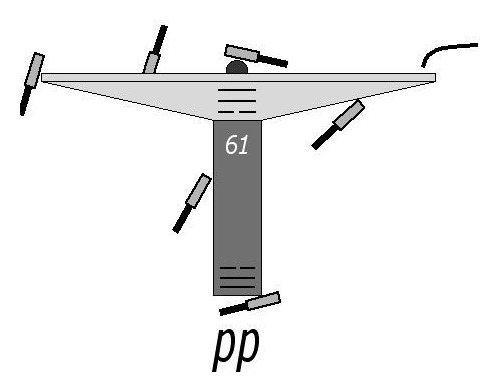 Graphic, or iconographic, notation represents the object being performed and does not
transfer or transcribe well to other sound objects or instruments.
If you want someone to hit the side of a bell, it is most efficient
to draw a bell with a stick hitting it. Traditional,
linear notation is far more abstract in this respect but is
flexible, transportable and gives a composer-performer a sense
of control. A graphic icon designed
to notate a sound texture is also a pictorial algorithm which,
in minute detail, is less likely to be played the same way on
each performance. Even so, we tend to identify all careful performances
of graphic notation as duplicates for the same reason we
identify different oak forests as oak forests.
Graphic, or iconographic, notation represents the object being performed and does not
transfer or transcribe well to other sound objects or instruments.
If you want someone to hit the side of a bell, it is most efficient
to draw a bell with a stick hitting it. Traditional,
linear notation is far more abstract in this respect but is
flexible, transportable and gives a composer-performer a sense
of control. A graphic icon designed
to notate a sound texture is also a pictorial algorithm which,
in minute detail, is less likely to be played the same way on
each performance. Even so, we tend to identify all careful performances
of graphic notation as duplicates for the same reason we
identify different oak forests as oak forests.
Linear notation, accept as it moves into more graphic territory, depicts texture poorly but better enables the perception, given a skilled musician, of being identical performance-to-performance. Most of us are adept at understanding and realizing texture, whether visually or aurally, while only a few will ever read linear notation efficiently--it takes a certain inate ability to play a piano piece by Pierre Boulez. It is, however, possible to notate statistically such as work iconographically, or even poetry, which could then be performed by untrained musicians. True, Boulez's work work from the 1950s is best presented as it is, but the iconographic method may result in something more interesting and then, if recorded, be mistaken as a lost Boulez!
From experience I have learned that iconographic notation has potential for producing modern artifacts of great beauty which are accessible, without being intellectually lazy or giving ground, by a larger group of people, even children and, therefore, is culturally useful.
A skill continuum is represented by these
two approaches to music notation. Just as the skills needed to
realize excellent representational painting and drawing will not
necessarily transfer to those needed to make, say, action-based
paintings, a first rate performer of traditional notation may
in fact be quite clumsy at realizing nonlinear, icongraphic works.
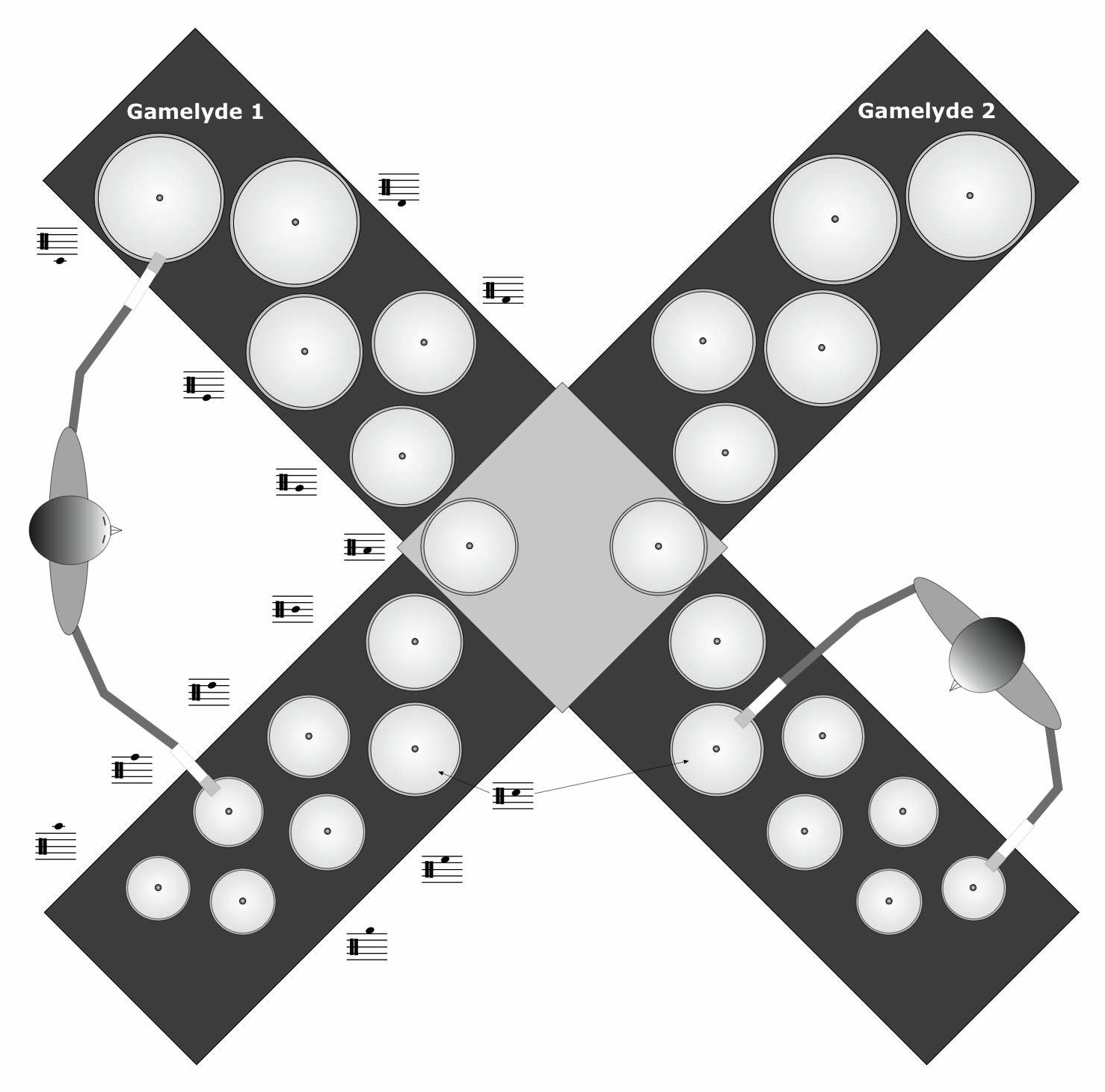
A linear form of notaton
has also be developed for the lydes along with four sound fonts for use
with midi equipment. These use the instruments as organized into Gamelydes comprised of 13 lydes each. Gamelydes of Dan's exist in Prague,
Eindhoven (Petra Dubach and Mario van Horrik), Milwaukee, and, of course, in Watertown, WI (Waterhouse Studio). The recordings made in September and October of 2016, with Dan performing at Waterhouse Studio in Watertown, were made using Gamelydes 1-4.

Translation and Use
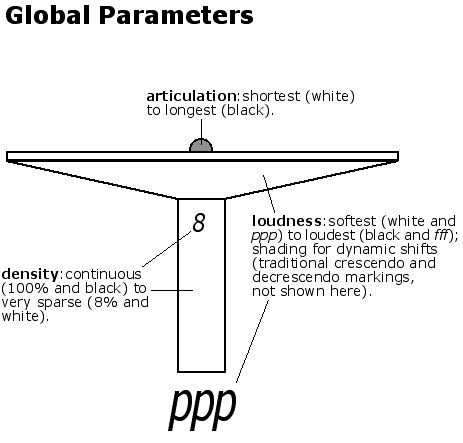
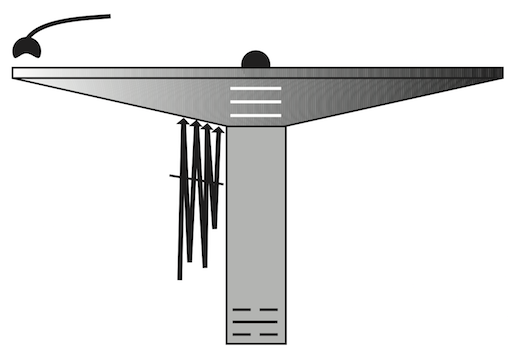 In lyde notation, an icon, or lycon,
represents one of 64 hexagrams from the I Ching and has been derived using a system
to extract global parameters from a hexagram along with subsequent
intuitive methods to tailor these to the subject of accompanying
texts. Each lycon represents a sound texture which is selected
by forming a question for the I Ching
which will result in one or two hexagrams (moving lines will provide
a second hexagram) and their associated lycon. Additional performers
can put forth similar (the same) questions to produce additional
lycons which can be arranged as the group sees fit, but those
produced by moving lines should be kept together. One lycon can
be performed, and then another, and another, or one can be merged
over time with another, and another... The performance strategies
for the lycons are endless, of course, and can include motion
(moving lycons or moving players) to explore the acoustics of
a space while encompassing an audience.
In lyde notation, an icon, or lycon,
represents one of 64 hexagrams from the I Ching and has been derived using a system
to extract global parameters from a hexagram along with subsequent
intuitive methods to tailor these to the subject of accompanying
texts. Each lycon represents a sound texture which is selected
by forming a question for the I Ching
which will result in one or two hexagrams (moving lines will provide
a second hexagram) and their associated lycon. Additional performers
can put forth similar (the same) questions to produce additional
lycons which can be arranged as the group sees fit, but those
produced by moving lines should be kept together. One lycon can
be performed, and then another, and another, or one can be merged
over time with another, and another... The performance strategies
for the lycons are endless, of course, and can include motion
(moving lycons or moving players) to explore the acoustics of
a space while encompassing an audience.
©Dan Senn 2018, BMI